5 Scheduling Systems High-Performing Entrepreneurs Use to Protect Their Most Productive Hours
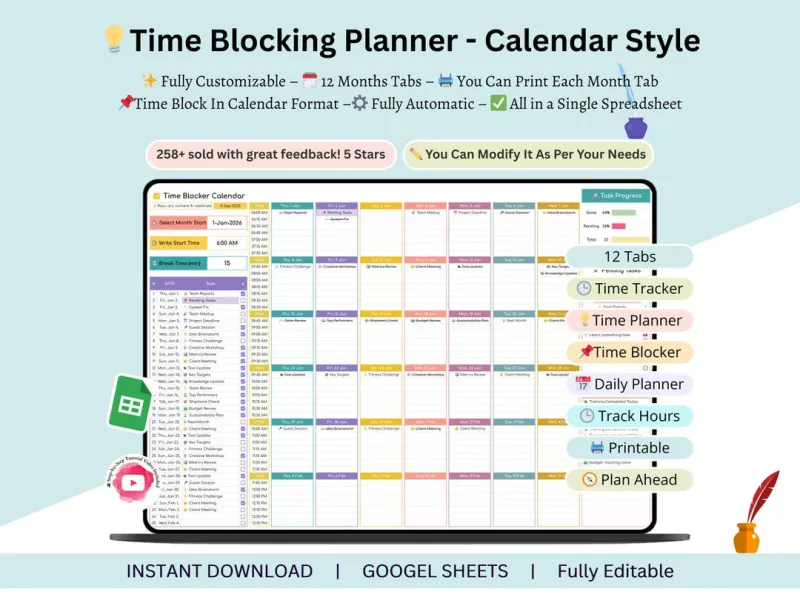
Photo: entrepreneur time blocking calendar planning organized desk productivity, via i.etsystatic.com
The Problem With an Open-Door Calendar
For many entrepreneurs, the calendar is less a tool of intention and more a document of surrender. Meetings accumulate wherever there is white space. Notifications fragment the morning. By the time the truly important work is supposed to begin, the day has already been spoken for.
This is not a discipline problem. It is a systems problem. And the good news is that systems can be built, refined, and—critically—supported by the right kind of virtual assistance.
The entrepreneurs who consistently operate at their highest level are not necessarily working longer hours or possessing some unusual capacity for focus. They have simply constructed their days around a set of intentional frameworks that defend their peak hours from the ordinary chaos of running a business. Here are five of the most effective.
1. The Time-Block Architecture
Time-blocking is one of the most well-documented productivity strategies in use today, favored by executives, creatives, and operators across nearly every industry. The principle is straightforward: rather than working from a to-do list, you assign every significant category of work a dedicated block of time on your calendar.
Deep strategic work gets the morning. Administrative review happens mid-afternoon. Calls and meetings are clustered on two or three designated days rather than scattered throughout the week.
What makes time-blocking difficult to sustain is the constant pressure of incoming requests that do not respect your schedule. This is where a virtual assistant becomes indispensable. When your VA is empowered to manage your calendar—accepting, declining, and rescheduling requests according to your established framework—time-blocking shifts from an aspiration to an operational reality.
2. The Communication Boundary Protocol
One of the most significant sources of productivity loss for business owners is not meetings or administrative work. It is the ambient noise of unstructured communication: the mid-morning Slack message that requires a decision, the email thread that pulls you into a problem you should not be solving, the phone call that could have been a two-line response.
High-performing entrepreneurs address this by establishing explicit communication boundaries—defined windows when they are available for input and response, and protected periods when they are not.
A virtual assistant can serve as the first point of contact for incoming communication during protected hours, triaging messages by urgency, drafting responses for routine inquiries, and flagging only what genuinely requires the owner's direct attention. This single function alone can recover hours of uninterrupted focus each week.
3. The Weekly Planning Ritual
Rather than approaching each Monday reactively, top-performing business owners treat weekly planning as a non-negotiable ritual—typically conducted on Friday afternoon or Sunday evening. During this session, they review the week ahead, confirm priorities, and ensure their calendar reflects their actual intentions rather than simply their obligations.
This practice requires reliable information: an up-to-date task pipeline, a clear view of pending commitments, and awareness of any logistical details that could affect the week's flow. A virtual assistant who actively maintains project trackers, prepares weekly briefing summaries, and surfaces relevant deadlines in advance makes this ritual far more effective—and far more likely to actually happen.
The difference between a weekly planning session with complete, organized information and one without it is the difference between strategic clarity and an educated guess.
4. The Meeting Minimization Framework
Not all meetings are created equal, and many that appear on a business owner's calendar should not be there at all. The meeting minimization framework is a deliberate filtering process: every meeting request is evaluated against a set of criteria before it is accepted. Does this require real-time conversation, or could it be resolved asynchronously? Is the owner's presence essential, or could a team member or VA attend and report back? Could a fifteen-minute call replace a sixty-minute block?
Implementing this framework requires consistent enforcement—which is precisely where many entrepreneurs struggle. Saying no to meeting requests, proposing asynchronous alternatives, and managing the social dynamics of declining invitations takes time and attention that most owners would rather spend elsewhere.
A skilled virtual assistant handles this friction naturally. Armed with your meeting criteria, they can respond to incoming requests on your behalf, propose alternatives, prepare agendas that keep necessary meetings efficient, and follow up on action items afterward—so the meetings that do occur actually move things forward.
5. The Priority Pre-Filter System
Even with strong time-blocking and communication boundaries in place, the sheer volume of decisions that reach a business owner each day can erode focus. The priority pre-filter is a system designed to ensure that by the time something reaches the entrepreneur's attention, it has already been assessed for relevance, urgency, and completeness.
In practice, this means the VA reviews incoming requests and tasks before they reach the owner, categorizing them by priority tier, gathering any supporting information needed for a decision, and presenting them in a consolidated format at a scheduled review time rather than as a stream of real-time interruptions.
This transforms the entrepreneur's decision-making experience. Instead of reacting to a fragmented flow of inputs throughout the day, they engage with a curated, organized summary—and make better decisions as a result.
The Role of Virtual Assistance in Sustaining These Systems
Each of the frameworks described above shares a common requirement: they depend on consistent execution to deliver results. A time-blocking system that gets overridden every Tuesday is not a system. A communication boundary that collapses under the pressure of a busy week provides no real protection.
This is the practical value of dedicated virtual assistant support. When a VA is genuinely integrated into your scheduling and operations—not just handling occasional tasks, but actively maintaining the infrastructure of your workday—these systems become self-sustaining rather than self-defeating.
The goal is not to create a perfectly optimized schedule on paper. It is to build an operational environment where your most valuable hours are reliably available for the work that only you can do. That requires systems. And systems, to be truly effective, require support.
Building Toward Consistent Peak Performance
Protecting your peak hours is not a luxury reserved for executives at large corporations. It is a legitimate operational priority for any entrepreneur who wants to grow a business without burning out in the process.
The five frameworks above are not theoretical ideals. They are practical, proven structures that real business owners use every day—supported, in most cases, by capable virtual assistants who make the difference between a system that works and one that simply sounds good in a planning session.
If your calendar does not currently reflect your priorities, the path forward begins not with more discipline, but with better structure.