Stop Expecting Your Virtual Assistant to Think Like You—It Is Costing Your Business Dearly
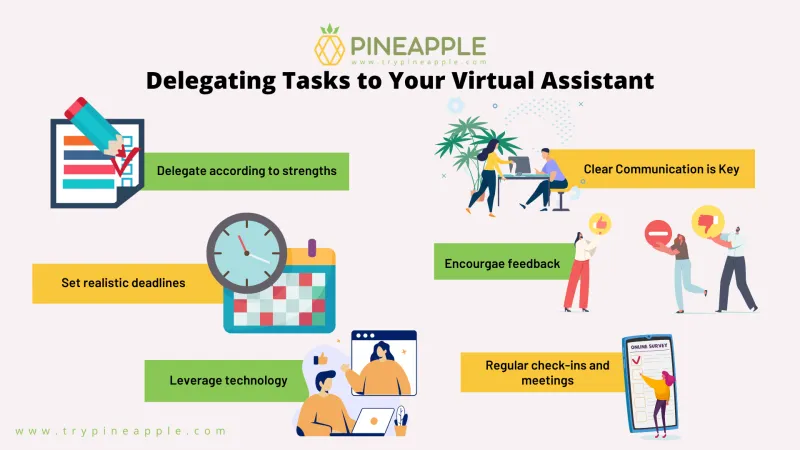
Photo: entrepreneur delegating tasks to virtual assistant on computer screen, via trypineapple.com
The Invisible Bottleneck Nobody Talks About
There is a particular kind of frustration that creeps into entrepreneur-VA relationships quietly and without warning. Tasks get completed, but not quite right. Communication loops multiply. Simple assignments require multiple rounds of clarification. And somewhere in the middle of all of it, a business owner begins to wonder whether hiring a virtual assistant was worth the investment at all.
In most cases, the problem has nothing to do with the assistant's competence. It has everything to do with a deeply embedded assumption that the entrepreneur carries into the working relationship from day one: the belief that their VA should approach work the same way they do.
This assumption is not born from arrogance. It is born from familiarity. When you have spent years running your business a certain way—jumping between priorities, making fast judgment calls, pivoting mid-task when something more urgent surfaces—that rhythm feels natural to you. It feels like productivity. What it actually is, in most cases, is controlled chaos. And when you delegate tasks with that same chaotic energy baked into the instructions, you are essentially asking your VA to inherit a system that was never efficient in the first place.
What Context Switching Actually Costs
Cognitive scientists have studied the cost of context switching for decades, and the findings are consistently sobering. Every time the human brain shifts from one type of task to another, it requires a period of reorientation—sometimes as brief as a few seconds, sometimes as long as twenty minutes, depending on the complexity of the work. For entrepreneurs who have trained themselves to live in that constant state of transition, the cost becomes invisible over time. They adapt. They compensate. They mistake busyness for output.
Virtual assistants, however, are most effective when they are not asked to replicate that pattern. The best-performing VAs operate in focused, structured blocks. They thrive when tasks are grouped by type, delivered with clear parameters, and assigned within a logical sequence. When an entrepreneur sends a stream of disconnected requests throughout the day—a calendar update here, a research assignment there, a client email sandwiched between a data entry request—they are not delegating efficiently. They are exporting their own context-switching habit into someone else's workflow.
The result is predictable: slower turnaround times, higher error rates, and a VA who is perpetually reactive rather than strategically productive.
The Psychology Behind the Mistake
Understanding why entrepreneurs fall into this pattern requires a brief examination of how most business owners learn to delegate in the first place. For the majority, delegation begins as a necessity rather than a strategy. Something becomes too time-consuming to handle personally, so it gets handed off—usually with minimal structure, because the entrepreneur is already stretched thin.
The implicit instruction in most of these handoffs is: do this the way I would do it, just so I do not have to do it myself. That framing places the VA in a subordinate role that limits their ability to contribute meaningfully. It also locks the business into whatever inefficiencies the entrepreneur had already built into their own process.
High-performing teams do not operate this way. In organizations where virtual assistance delivers measurable results, there is a clear understanding that different roles require different operating rhythms. The entrepreneur's role is inherently high-context, high-interruption, and judgment-driven. The VA's role is most effective when it is structured, repeatable, and execution-focused. These are not competing approaches—they are complementary ones, provided the business owner is willing to stop treating them as interchangeable.
A Framework for Role-Aligned Delegation
Restructuring the way you delegate begins with a simple but powerful shift in perspective: instead of asking what do I need done, start asking what type of work is this, and who is best positioned to execute it without unnecessary friction.
Here is a practical three-part framework for making that determination:
Categorize before you assign. Before sending any task to your VA, identify whether it falls into one of three buckets: administrative and logistical work, research and information gathering, or communication and client-facing support. Tasks within the same category should be batched together whenever possible. Sending five administrative tasks at once is exponentially more efficient than trickling them out across a full workday.
Eliminate judgment gaps before handoff. The most common source of rework in VA relationships is ambiguity. When a task requires your VA to guess at your preference—because the instructions were incomplete or assumed shared context that does not exist—you create a feedback loop that consumes more time than the task itself. Before delegating, ask yourself: does this instruction contain everything my VA needs to complete this without coming back to me? If not, fill the gap before you send it.
Design for their workflow, not yours. This is the most counterintuitive step, and the most important one. Identify the conditions under which your VA does their best work—whether that means receiving a consolidated task list at the start of the day, working within a shared project management platform, or having clearly defined turnaround windows—and build your delegation habits around those conditions. You are not lowering your standards. You are raising your output.
What Impeccable Execution Actually Looks Like
The most productive entrepreneur-VA relationships share a common characteristic: the entrepreneur has stopped trying to clone their own working style and started designing a system that allows each party to operate at their highest level.
When that shift happens, something notable occurs. Tasks stop falling through the cracks. Communication becomes more precise. The VA begins anticipating needs rather than simply reacting to them. And the entrepreneur, freed from the constant overhead of managing an inefficient delegation process, recovers hours that can be reinvested in the work that actually requires their presence.
Virtual assistance, at its best, is not about replicating what you do. It is about building a working structure where what you do and what your VA does combine into something more effective than either party could produce alone. That outcome does not happen by accident. It happens when business owners are willing to examine their own habits honestly and make the adjustments that impeccable performance actually requires.